Ketones, The Fourth Fuel: Warburg to Krebs to Veech, the 250 Year Journey to Find the Fountain of Youth by Travis Christofferson
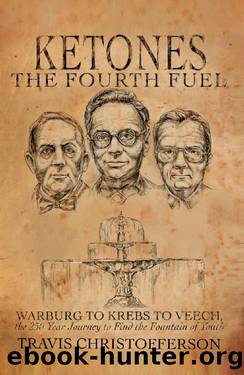
Author:Travis Christofferson [Christofferson, Travis]
Language: eng
Format: epub
Publisher: Travis Christofferson
Published: 2020-08-17T20:00:00+00:00
Cahillâs research illuminated the entire metabolic conversion to ketosis that is set in motion when a person stops eating. Insulin provides the key signal. With no carbohydrate stimulating the release of insulin, fat cells are quickly mobilized, releasing triglycerides into the bloodstream. This solves the food shortage for the many tissues that are able to use fatty acids for energy through a process called beta-oxidation that takes place in the mitochondria. A fatty acid is a chain of linked carbon atoms with varying numbers of hydrogen atoms attached along the chain (Fats with more hydrogens are called saturated fats and those with fewer hydrogens are unsaturated fats). The beta in beta-oxidation refers to the second carbon atom in from the end of the chain. For beta-oxidation to occur, enzymes first cut the fatty acid chain at the beta carbon bond, producing a two-carbon molecule called acetate that combines with coenzyme A to form acetyl-coA. Acetyl-coA can then enter the Krebs cycle electron transport chain ATP.
The hepatocytes in the liver act as the manufacturing line for ketone bodies. They do the work of pumping out ketone bodies primarily to meet the voracious energy appetite of the brain. Fatty acids enter hepatocytes and start the process of beta-oxidation, generating acetyl-CoA. But hereâs the critical difference between normal carbohydrate metabolism and what happens as a result of the shift to ketosis in liver cells: during ketosis, the final product of the Krebs cycle, oxaloacetate, is pulled from the cycle and shuttled through a gluconeogenic pathway to help generate glucose. With little oxaloacetate to bind with acetyl-coA (the final step in the Krebs cycle), the pool of acetyl-coA begins to build up. The enzyme that converts acetyl-coA into the ketone body acetoacetate is freely floating around in the mitochondrial matrix, just waiting to do its job. Now, with acetyl-coA spilling over into the mitochondrial matrix, this enzyme begins converting the excess acetyl-coA into acetoacetate. Another enzyme then converts acetoacetate into beta-hydroxybutyrate. Finally, beta-hydroxybutyrate and acetoacetate are released into the circulation as water-soluble molecules (about 2/3 BHB, 1/3 acetoacetate and a negligible amount of acetone generated from acetoacetate spontaneously breaking down).
The brain isnât the only organ that then imports and burns the ketone bodies circulating in the bloodâthe heart and muscle do, too. The metabolic transition to ketosis, Cahill then showed, has a built-in mechanism that regulates the entire processâan elegant feedback loop of regulatory control. The accumulation of beta-hydroxybutyrate in the blood circles back to adipose tissue and signals for it to slow down the release of triglycerides into the bloodstream, thus ensuring fuel is efficiently metered out only as needed.
What Cahill revealed was a finely tuned auxiliary metabolism that is hidden inside of all of us. Far from pathological, it has been essential to our survival. âThus, a normal adult human could survive two months of starvation; an obese person could survive much longer,â wrote Cahill. âWere it not for the β-hydroxybutyrate and acetoacetate providing brain fuel, we Homo sapiens might not be
Download
This site does not store any files on its server. We only index and link to content provided by other sites. Please contact the content providers to delete copyright contents if any and email us, we'll remove relevant links or contents immediately.
Unwinding Anxiety by Judson Brewer(72971)
The Art of Coaching by Elena Aguilar(53160)
The Fast Metabolism Diet Cookbook by Haylie Pomroy(21125)
Rewire Your Anxious Brain by Catherine M. Pittman(18630)
Healthy Aging For Dummies by Brent Agin & Sharon Perkins RN(17032)
Talking to Strangers by Malcolm Gladwell(13338)
The Art of Thinking Clearly by Rolf Dobelli(10404)
Mindhunter: Inside the FBI's Elite Serial Crime Unit by John E. Douglas & Mark Olshaker(9308)
Crazy Rich Asians by Kevin Kwan(9268)
The Compound Effect by Darren Hardy(8918)
Tools of Titans by Timothy Ferriss(8357)
Periodization Training for Sports by Tudor Bompa(8242)
Becoming Supernatural by Dr. Joe Dispenza(8192)
Wonder by R. J. Palacio(8095)
Crystal Healing for Women by Mariah K. Lyons(7917)
Bodyweight Strength Training by Jay Cardiello(7900)
Change Your Questions, Change Your Life by Marilee Adams(7727)
Therapeutic Modalities for Musculoskeletal Injuries, 4E by Craig R. Denegar & Ethan Saliba & Susan Saliba(7709)
Nudge - Improving Decisions about Health, Wealth, and Happiness by Thaler Sunstein(7687)
